
From electrical repairs to landscaping, pest control, and routine maintenance, owners corporations and body corporates frequently engage contractors to work on common areas. While these services are essential to the upkeep of property, they also introduce legal, safety, and reputational risks, particularly if these service providers are not properly vetted and informed before starting work.
Therefore, specific work, health and safety (WHS) obligations and duties of care need to be met when engaging with contractors for common property work.
Under Workplace Health and Safety (WHS) laws, several duty holders are responsible for managing, eliminating, or reducing risks, especially when work is performed at heights on common property. Key duty holders include:
Individuals or organisations considered a person conducting a business or undertaking (PCBUs) or a person with management and control of a workplace, has a duty to manage, eliminate, or minimise risks associated with work done on common property as reasonably practicable. This typically includes owner corporations and body corporates, particularly when they engage a worker or contractor to do repair and maintenance work on common property within mixed-use residential and commercial property. In this scenario, the common property is deemed a ‘workplace’, which requires the owners corporation or body corporate to establish a work health and safety risk management system that aligns with regulatory standards, including:
Contractors are responsible for ensuring compliance with health and safety regulations by fulfilling the following obligations:
State | Legislation |
NSW | |
QLD | |
VIC | Occupational Health And Safety Regulations 2017 (Division 9) |
Failure to meet WHS obligations can result in legal liability, severe financial penalties, and an increased risk of accidents on common property. Further risks can include:
Consultation between the owners corporation or body corporates, contractors, and other duty holders is essential to understand and agree on how the work can be safely carried out on common property. Open discussions help identify potential hazards, clarify roles, and establish the necessary risk mitigation measures, such as fall protection systems or the use of specialised equipment. These conversations are essential to the risk management and ensure contractors are properly prepared to protect themselves and others on site.
Before any work begins, it is essential to discuss and agree on key aspects of the project, including:
The onsite building manager or caretaker is the best person to facilitate the induction process.
To meet health and safety obligations, owners corporations, body corporates, and contractors have a shared responsibility to carry out individual detailed risk management assessments relevant to the work being conducted on common property.
The risk management process is a cycle of important steps that duty-holders must follow to keep everyone safe. It involves identifying, assessing, controlling, and monitoring potential hazards on the common property. By following these four steps carefully and regularly, the committee can comply with health and safety laws, reducing the chances of accident, injury, or legal issues.
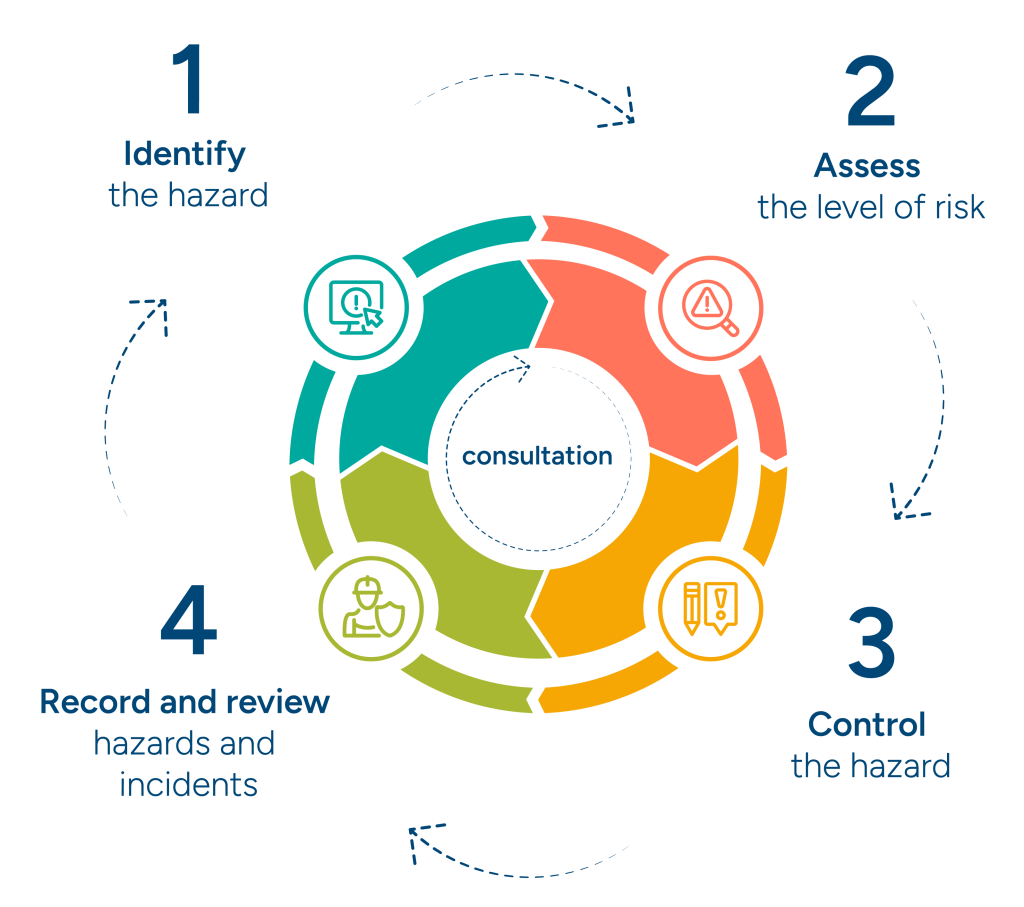
The following guidelines provide a general outline of key best practice requirements and measures when dealing with contractors working onsite. It outlines best practices for occupational health, safety, and injury management and key obligations under WHS regulations.
This guide does not replace the law, as your specific state legislation will always take precedence. Furthermore, the contractor should be familiar with all relevant legislative requirements.
Before commencing work, contractors must be aware of the specific rules that apply to the strata property. This includes access hours, common property restrictions, and permitted noise levels. Contractors should also be aware of where they can and cannot park, and any limitations regarding the use of lifts or shared amenities. Clear site rules reduce disruptions to residents and help maintain harmony on site.
All contractors should have an overview of workplace health and safety procedures specific to the property. This includes identifying any known hazards, evacuation points, fire safety equipment locations, and incident reporting protocols. Understanding the safety landscape of the site is vital to protecting both contractors and residents and minimising risk.
Contractors are typically required to sign in and out each day they are on site. This helps maintain a clear record of who is working on the property and ensures accountability. Contractors may need to provide identification and specify the type of work being performed. This step also assists emergency services in the event of an onsite incident.
Clear communication is key to smooth operations. During induction, contractors are given details for key personnel, such as the strata manager or building manager. These contacts should be used to report issues, request access, or clarify project requirements. Having the right contact information reduces delays and keeps works on track.
Contractors are expected to follow the property’s environmental and waste management guidelines. This includes proper disposal of construction waste, avoiding environmental hazards, and keeping common areas tidy. Encouraging responsible practices helps protect the property’s appearance and environmental footprint and demonstrates respect for the shared community space.
Contractors should be aware of any legal or regulatory compliance expectations related to their work. This may include licensing, insurance coverage, working with children checks (if applicable), or adherence to relevant WHS laws. Confirming that all compliance obligations are met protects the owners corporation or body corporate from liability and ensures all work is performed legally and professionally.
Safety is paramount when working at heights, especially where there’s a risk of falling more than two metres. Before starting any work at height, a thorough risk assessment must be completed. In cases where installing handrails, edge protection, or similar measures are impractical, all workers must use an approved safety harness with a lanyard secured to a compliant anchor point, as per Australian Standard AS1891.
Additionally, all scaffolding and working platforms must meet statutory and Australian Standard requirements, whether suspended or not. Only licensed professionals are authorised to erect these structures, ensuring their stability and worker safety.
Contractors have a responsibility to maintain safe excavation and trenching practices. This includes ensuring that all excavations are adequately shored to prevent collapses and that safe access is always available. To comply with legal requirements, trenches must be equipped with appropriate protective measures, such as handrails, barricades, and clear warning signs.
Furthermore, daily inspections of excavations and trenches must be carried out by a competent individual. If signs of instability, such as slides or cave-ins, are observed, work in the affected area must be immediately halted until safety precautions are implemented. To further minimise risks, materials must be stored at least one metre away from the edge of any excavation, preventing accidental dislodgment.
According to WHS Regulations, owners corporations or body corporates must ensure that ‘confined spaces’ are managed and made reasonably safe for contractors. This can sometimes include underground parking ventilation ducts, water storage tanks, stormwater pits, utility rooms, lift shafts, and plumbing or electrical tunnels.
The classification of a ‘confined space’ depends on the hazards it presents, not simply its size. This is typically an enclosed or partially enclosed area that is not designed for human occupancy and is at normal atmospheric pressure when accessed. These spaces can pose significant health and safety risks, including unsafe oxygen levels, harmful airborne contaminants (gases, vapors, dusts), fire or explosion hazards, or risks of engulfment.
Furthermore, contractors and their workers must adhere to the requirements outlined in the Workplace Health and Safety (Confined Spaces) Regulation when performing tasks in confined areas. Compliance with these rules is essential to ensure safety and reduce risks associated with confined space work.
Contractors handling dangerous goods or hazardous substances onsite are responsible for safely managing these materials. They must:
Certain areas of common property are equipped with automatic fire detection systems that are directly connected to emergency services. The contractor must coordinate and ensure proper procedures are followed to protect these systems or have them temporarily disabled during work for activities like demolition, hot work, or tasks that generate dust, fumes, moisture, or vibrations.
If you encounter an unsafe condition that requires urgent attention, take action to correct it if it is within your expertise. If you cannot resolve the issue, make the area as safe as possible and immediately report the problem to the owners corporation or body corporate manager.
However, if the situation is an emergency, please call local authorities or the relevant provider:
Any hazard, near miss, incident, injury or illness sustained during any works undertaken must be reported immediately to the owners corporation or body corporate manager or our Community Health & Safety through our online form at picagroup.com.au/community-health-safety/report.
If an incident occurs which constitutes a ‘notifiable incident’ the contractor will immediately advise the owners corporation or body corporate manager) who will, in turn, report the incident to Work Safe Australia.
If there is a death or serious injury, the site must not be disturbed beyond:
If an emergency occurs while you are on common property:
At PICA Group, we are committed to helping our customers access qualified and licensed contractors for common property. To maintain this standard, all contractors must undergo a comprehensive induction process before commencing any work. This process is designed to protect the interests of our clients, maintain compliance with legal and safety requirements, and uphold the integrity of our communities.
Contractors must be registered and approved through our CommunitySelect platform. They must provide evidence of:
Contractors must agree to the PICA Group’s terms and conditions, which outline their responsibilities, including:
Contractors must adhere to the PICA Group contractor code of conduct, which includes:
PICA Group reserves the right to conduct audits and inspections to help you maintain ongoing compliance.
Owners corporations or body corporates that are considered PCBU’s may have the duty to provide asbestos information to contractors. Our work order system supports this by automatically attaching the building’s asbestos documentation, terms and conditions, and code of conduct.

Contractor inductions are a fundamental part of any WHS risk management process. By educating workers and service providers about site-specific hazards, expectations, and emergency procedures, owners corporations and body corporates can significantly reduce the chance of incidents and maintain compliance with regulatory obligations.
If you require additional support or more specific instructions regarding contractor inductions, don’t hesitate to contact or consult your direct manager for further clarification.
Our Community Health & Safety service is here to help provide schemes with appropriate mechanisms to manage these risks while ensuring the obligations under the regulations are met. Through our resource library, online reporting system, and centralised repository, we are here to help support you in managing your health and safety obligations.
Each state may have specific legislation and regulations concerning health and safety duties in owner corporations and body corporates. To help navigate these regulations, Safe Work Australia, a national policy body, offers a range of resources and tools to help committees manage hazards and risks. For the latest general WHS updates, guidance, and recommendations, please visit the official Safe Work website at safeworkaustralia.gov.au.

This article is edited by Lauren Shaw Regional General Manager and Licensee-in-Charge on July 2025.